
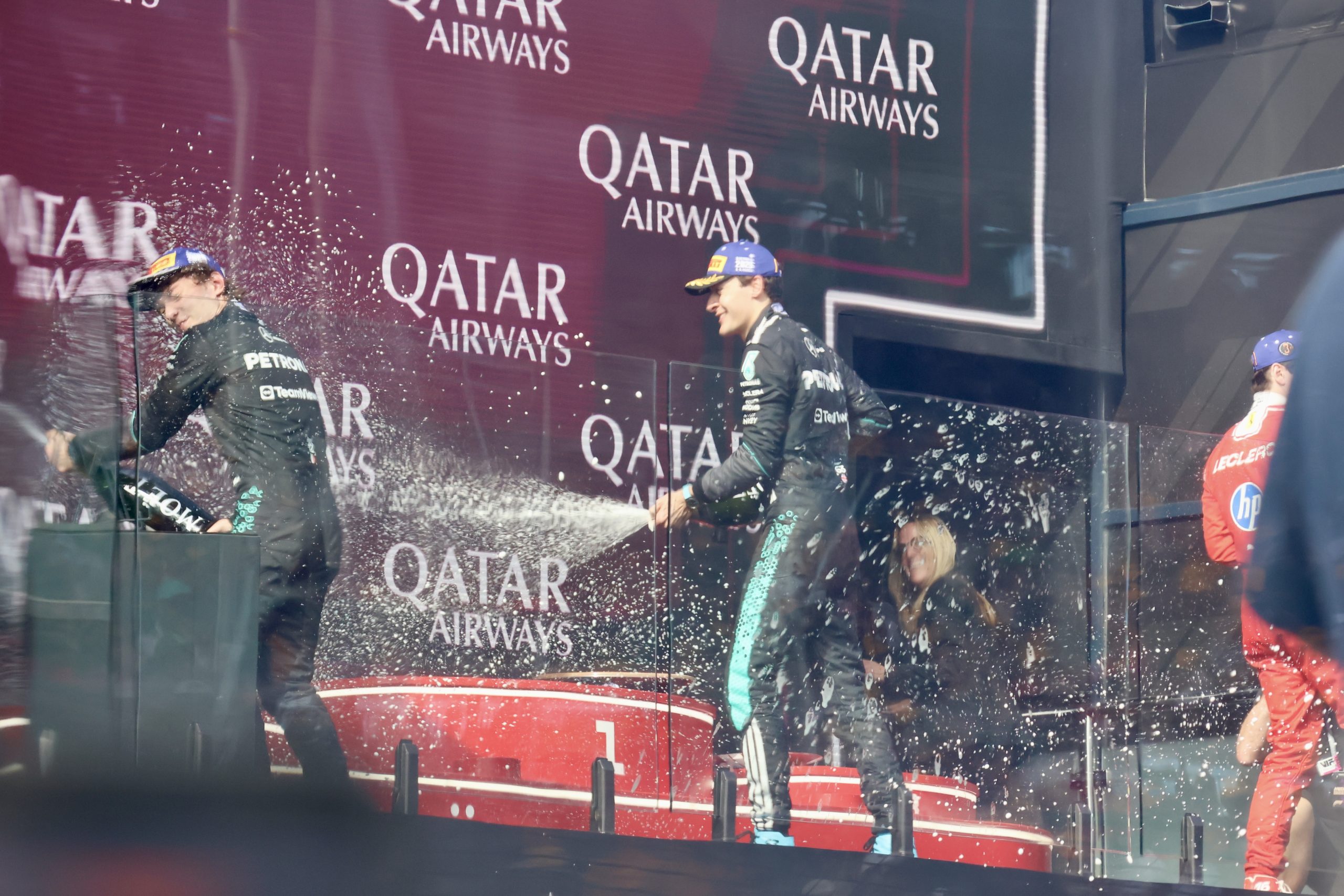
Albert Park delivered everything you’d want from an opening round: a shock DNS, a superstar fighting from the back of the grid, a strategic battle that pivoted on three safety car phases, and a winner who described his own qualifying pace as a surprise. George Russell took the chequered flag by 2.974 seconds from team-mate Andrea Kimi Antonelli, with Charles Leclerc and Lewis Hamilton completing the top four for a Ferrari side that will spend the flight home asking hard questions about strategy.
Here is how Round 1 of the 2026 season unfolded.
Before the Lights Even Went Out
Drama is one thing. Chaos before the formation lap is another. Oscar Piastri — who had qualified fifth and was one of the headline acts for this new technical era — crashed his McLaren on the reconnaissance laps at Turn 4. The car was too damaged to race. He did not start.
Nico Hülkenberg never made it that far. A power unit issue saw him wheeled off the grid before he could take his place. Two of the twenty cars that completed qualifying were gone before a wheel had been turned in anger.
Max Verstappen was starting from the back regardless — a Q1 crash had ended his qualifying session early, and stewards granted him permission to start despite failing to set a time within 107% of the Q1 benchmark, on the basis of his practice performances. He lined up P20 on hard tyres while the majority of the grid took mediums.
The new 2026 cars also brought fresh complexity to the start procedure itself. Russell would later describe being undercharged on battery at lights out — a consequence of the revised energy deployment rules under the new regulations. Ferrari did not have that problem.
Lap One to Leclerc — Then the Chess Match Begins
Leclerc launched from fourth and was through into Turn 1 in front. Antonelli, from the front row, tumbled back to seventh in the scramble. Russell, on pole, found himself in second.
What followed over the next ten laps was the most visible demonstration yet of what the 2026 power unit regulations mean for racing. The Overtake and Boost deployment systems — which distribute battery power across multiple straights — turned the early exchanges into a rapid pass-and-repass sequence. Russell attacked, Leclerc responded. The lead changed hands multiple times in the space of a few laps. A move made with deployment on one straight left the attacker vulnerable on the next. As Russell later put it, the challenge is how you divide 100% battery across four straights — and your opponent has the same problem.
By lap nine, Russell had worked his way into a position to attack in earnest. A heavy lock-up into Turn 1 altered his front tyre state and briefly shifted the momentum back toward Ferrari. But the decisive moment of the race was about to arrive — and it had nothing to do with either of them.
The VSC That Won the Race
On lap 11, Isack Hadjar coasted to a halt with a power loss and smoke trailing from the rear of his Red Bull junior car. Virtual Safety Car. Both Mercedes drivers were in immediately — a double-stack at the pit entry — and came back out on hard tyres. Ferrari kept both cars on track.
“We saw the VSC coming and we knew what we had to do. The hard tyre from lap 12 to the end — that was the race.” This, more or less, is how Mercedes framed it afterward.
Ferrari’s logic was not irrational. Multiple VSC phases had already punctuated the weekend, and Leclerc’s team calculated that another neutralisation was likely — at which point they could stop at lower cost, potentially leapfrogging Mercedes on fresher rubber. It was a considered gamble. It did not pay off.
A second VSC arrived when Valtteri Bottas stopped close to the pit entry, triggering another slow zone. But the pit lane entry was closed at the key moment for Ferrari, preventing the inexpensive stop they had been waiting for. Verstappen, running a contrarian hard-tyre opening stint, came in for mediums. Ferrari stayed out again.
When Leclerc finally pitted on lap 25 and Hamilton on lap 28, Russell and Antonelli were back ahead — and now the question was whether they could hold on to the end.
Verstappen: P20 to P6, Fastest Lap
While the frontrunners managed tyres and VSC windows, Verstappen was doing something different. Starting from the back on hards, he carved forward through the field with the measured aggression that is now almost routine — an opportunistic pit for mediums mid-race, a final set of hard tyres late on, and a fastest lap to underline the point. He finished sixth. From twentieth. In a car that was, by all accounts, not the fastest thing on track.
A penalty for Colapinto added colour to the mid-race period — the Franco-Argentine received a stop-and-go for his team touching the car after the 15-second signal, a mandatory sanction under the sporting regulations and a reminder that the stewards arrived in Melbourne with clear standards to enforce.
The Final Lap Count
DNF / DNS: Piastri (did not start — pre-race crash), Hülkenberg (did not start — power unit), Hadjar (retirement, lap 11 — power loss), Bottas (retirement, mid-race — near pit entry).
| Pos | Driver | Team | Strategy | Gap |
|---|---|---|---|---|
| 1st | George Russell | Mercedes | 1-stop · Medium → Hard (lap 12) | 1:23:06.801 |
| 2nd | Andrea Kimi Antonelli | Mercedes | 1-stop · Medium → Hard (lap 12) | +2.974s |
| 3rd | Charles Leclerc | Ferrari | 1-stop · Medium → Hard (lap 25) | +15.519s |
| 4th | Lewis Hamilton | Ferrari | 1-stop · Medium → Hard (lap 28) | +16.144s |
| 5th | Lando Norris | McLaren | 2-stop · Medium → Hard → Medium (laps 11, 34) | +51.741s |
| 6th | Max Verstappen | Red Bull | 2-stop · Hard → Medium → Hard (laps 18, 41) | +54.617s |
| 7th | Oliver Bearman | Haas | 1-stop · Medium → Hard (lap 18) | +1 lap |
| 8th | Arvid Lindblad | Racing Bulls | 1-stop · Medium → Hard (lap 18) | +1 lap |
| 9th | Gabriel Bortoleto | Audi | 2-stop (laps 18, 33) | +1 lap |
| 10th | Pierre Gasly | Alpine | 1-stop · Medium → Hard (lap 11) | +1 lap |
What It Means: The Early Championship Picture
Russell leads the Drivers’ Championship on 25 points. Antonelli sits second on 18 — a remarkable debut result for a 19-year-old in his first race as Russell’s team-mate. Leclerc is third on 15, Hamilton fourth on 12.
Mercedes leads the Constructors’ Championship with 43 points. Ferrari have 27.
One race is not a season, and Russell himself acknowledged that the Mercedes qualifying advantage came as a surprise — even internally. Ferrari’s race pace was real; the 15-second gap at the flag flatters Mercedes. Had Ferrari pitted during that first VSC, we might be writing a very different story.
The early 2026 picture is this: the regulations have changed everything, and nobody fully knows where the chips will fall. Battery deployment is now a racecraft weapon as much as a performance metric. The VSC lottery is not going away. And somewhere in a Red Bull garage, a four-time world champion finished sixth from the back of the grid and quietly took fastest lap on his way out.
Leave a Reply