
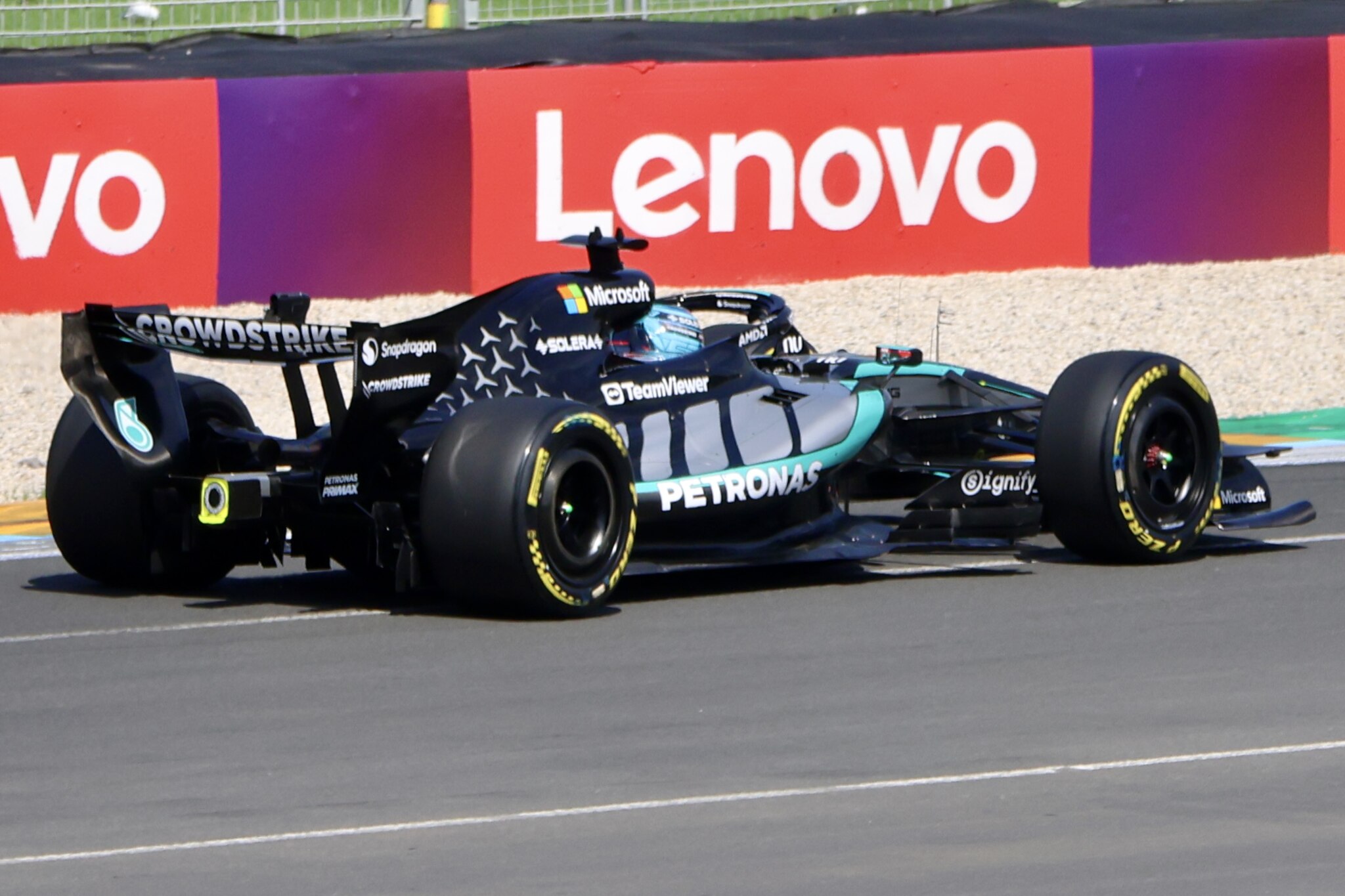
The Chinese Grand Prix is Round 2 of 2026, and it arrives with a twist: this is the season’s first Sprint weekend. That means teams get exactly one hour of practice before Sprint Qualifying begins. One session to understand a new car on a new track under new regulations. It tends to separate those who arrived with clear answers from those who were still looking for the questions.
Mercedes land in Shanghai as the benchmark after a commanding 1–2 in Melbourne. Ferrari arrive knowing their race pace is closer than the qualifying gap suggested, but aware that “closer” is not the same as “there.” And a grid full of engineers is about to find out whether everything they learned in Australia translates to a very different kind of circuit.
Weekend Schedule
⏰ All times below in Shanghai local time (UTC+8)Shanghai is 8 hours ahead of UTC. European fans: subtract 7 hours for UK time, 8 for CET.
| Session | Day | Local Time (UTC+8) | UTC |
|---|---|---|---|
| Practice 1 | Friday 13 Mar | 11:30 – 12:30 | 03:30 – 04:30 |
| Sprint Sprint Qualifying | Friday 13 Mar | 15:30 – 16:14 | 07:30 – 08:14 |
| Sprint Sprint Race | Saturday 14 Mar | 11:00 – ~11:30 | 03:00 – ~03:30 |
| Qualifying | Saturday 14 Mar | 15:00 – 16:00 | 07:00 – 08:00 |
| Race Grand Prix | Sunday 15 Mar | 15:00 – 17:00 | 07:00 – 09:00 |
The Circuit: Why Shanghai Is So Different From Melbourne
Albert Park is a stop-start street-adjacent circuit where energy deployment and traction matter most. Shanghai International Circuit is something else: 5.451 km of sustained, high-load corners, a 1.2 km straight hammering into one of the heaviest braking zones on the calendar, and 56 laps that ask the same question of your tyres, over and over again.
The key technical phrase you’ll hear from engineers all weekend is front-limited. The Turn 1–2–3 complex subjects front tyres — particularly the front-left — to prolonged lateral load, and if you push too hard, the tyre surface starts to grain. Once it’s grained, you’re managing a sliding car into the slowest corners on track, bleeding time and running the clock down on a tyre that feels worse with every lap.
The best car at Shanghai often looks slightly underwhelming on a single hot lap early in the weekend. Then it holds together when others fall apart.
That reality shapes everything: setup philosophy, tyre allocation strategy, even qualifying approach. A setup that chases pure lap time can grain the front-left in Q3 and spend the race weekend paying for it. A setup that protects the tyre surface often looks slightly pedestrian in the Saturday heat — and then runs away from the field in the last 20 laps of Sunday.
Under the 2026 regulations, there’s a second dimension. Shanghai features multiple major braking zones — most notably the long haul into Turn 14 — which are prime energy recovery opportunities. Teams are still learning how to sequence deployment and harvest across a layout this demanding, and that learning curve is compressed even further by the one-practice constraint.
The pit-lane time loss is listed at 23.67 seconds, including stationary time. That’s meaningful: a second stop needs to buy genuine pace or a strategic advantage to justify itself, which points firmly toward a one-stop baseline for the Grand Prix.
Circuit facts at a glance
| Stat | Value |
|---|---|
| Circuit length | 5.451 km |
| Race distance | 56 laps / 305.066 km |
| Corners | 16 |
| Pit-lane time loss | 23.67 seconds (incl. 2.5s stationary) |
| Safety Car probability | 55% |
| VSC probability | 33% |
Tyres: Manage the Front-Left or Pay the Price
Pirelli’s nomination for Shanghai is C2 (Hard), C3 (Medium), C4 (Soft) — a step softer than some circuits, reflecting the preference for a compound that generates heat quickly in cooler early-spring conditions.
Forecasts point to mild temperatures across the weekend window, with highs in the mid-teens Celsius. That’s an important variable: cooler air slows tyre warm-up, which can make first-lap pace and early-stint positioning even more decisive than usual. Teams that can get their medium or hard tyres switched on quickly through the opening sector will have a meaningful edge.
| Compound | Pirelli designation | Sprint allocation | Primary role |
|---|---|---|---|
| Hard | C2 | 2 sets | Grand Prix race tyre / Sprint option |
| Medium | C3 | 4 sets | Expected race start / Sprint baseline |
| Soft | C4 | 6 sets | Qualifying / short Sprint stints |
The Sprint is expected to be a no-stop affair, with a preference for the Hard tyre — though Medium starts are possible depending on grid position and how aggressively teams want to protect their Sunday allocation. The allocation is tight enough (just 2 sets of Hards per driver) that every strategic decision across the weekend has a downstream consequence.
For the Grand Prix itself, the one-stop is the baseline expectation. Graining — not outright thermal degradation — is the dominant tyre challenge, driven by sustained sliding through Turn 1–2, Turn 8, and the Turns 12–13 sequence. The key unknown, as ever with a new car on a new tyre, is how the 2026 compounds interact with Shanghai’s surface under the altered aero loads and energy deployment patterns of the new rules.
With a 55% Safety Car probability, teams will absolutely keep a contingency plan alive. But the 23.7-second pit-loss figure means no-one will be jumping at shadows — a “cheap stop” only becomes cheap if the VSC or SC window genuinely reduces that cost below a meaningful threshold.
The Storylines That Matter
1. Can the Mercedes benchmark survive a different circuit?
Russell won in Melbourne and described the Mercedes qualifying pace as a surprise even internally. Ferrari’s framing has been consistent: the race gap is smaller than the qualifying delta, and that is where they see their opportunity. Shanghai, with its emphasis on balanced chassis performance through long loaded corners, may be more representative of the broader season battleground than the chaotic streets of Albert Park.
The question for Mercedes is simple: was Australia a circuit-specific advantage, or have they genuinely found something in the architecture of the 2026 regulations that translates across different tracks?
2. Ferrari’s “flip-flop” wing: development test or genuine weapon?
The storyline that engineers and aerodynamicists will be watching most closely is Ferrari’s plan to run an innovative rotating rear wing concept — nicknamed the “flip-flop” or “Macarena” wing in paddock shorthand — in Friday’s sole practice session. Shanghai’s 1.2 km straight into Turn 14 provides the ideal test bed for any aero efficiency concept.
Ferrari’s drivers have been careful not to oversell it. The framing from the team is that engineering “work” remains and meaningful optimization is still needed on single-lap pace. But running a novel concept this early — in a one-practice Sprint weekend, no less — suggests they believe the development direction is worth exploring aggressively.
3. Piastri’s reset: from DNS to Sprint format
Oscar Piastri’s Australia weekend ended before it began. A crash on the reconnaissance laps left him a spectator for the first race of the new 2026 era. He arrives in Shanghai with pace that was already established across late 2025 — multiple front-row starts, a strong head-to-head record with Norris — but zero data on how the McLaren behaves under 2026 regulations in race conditions.
A Sprint weekend, with its condensed format and limited practice, is both an opportunity and a pressure test. Clean execution across FP1 and Sprint Qualifying sets a trajectory. Mistakes here, with no time to recover, can define an entire weekend.
4. Reliability: the subplot that refuses to leave
Australia cost multiple drivers their weekends before the race had even started. Hülkenberg and Piastri did not start. Hadjar and Bottas retired. Aston Martin’s pre-season was openly described as turbulent. The reliability picture across the grid is uneven, and a Sprint weekend — with more competitive running crammed into fewer sessions — amplifies the risk for anyone carrying a fragile component.
Form Guide: Recent Results That Tell You Something
The table below covers the five most recent Grands Prix before China: 2025 São Paulo, Las Vegas, Qatar, Abu Dhabi, and 2026 Australia. It tells you who is converting grid positions into points — and where reliability anomalies are distorting the picture.
| Driver | Finishes (last 5 GPs) | Pts | Key note |
|---|---|---|---|
| George Russell | 4 / 2 / 6 / 5 / 1 | 73 | Consistent front-running conversion across very different circuits |
| Kimi Antonelli | 2 / 3 / 5 / 15 / 2 | 61 | High ceiling; results volatile when things go sideways |
| Lando Norris | 1 / DSQ / 4 / 3 / 5 | 62 | Multiple poles in late 2025; qualifying speed is a habit |
| Max Verstappen | 3 / 1 / 1 / 1 / 6 | 98 | Race results remain elite; qualifying incident in Australia the only blemish |
| Oscar Piastri | 5 / DSQ / 2 / 2 / DNS | 46 | Pace clearly there; zero 2026-spec race data is the gap |
| Charles Leclerc | DNF / 4 / 8 / 4 / 3 | 43 | Strong when finishing; race pace at Ferrari’s recent benchmark |
| Lewis Hamilton | DNF / 8 / 12 / 8 / 4 | 20 | Ferrari race pace encourages; floor-level DNFs are still recent memory |
| Oliver Bearman | 6 / 10 / DNF / 12 / 7 | 15 | Consistent midfield scorer; P7 in Australia shows the ceiling is rising |
| Arvid Lindblad | —/—/—/—/ 8 | 4 | Points on debut in Melbourne. Baseline established. |
| Fernando Alonso | 14 / 11 / 7 / 6 / DNF | 20 | Aston Martin’s reliability narrative still the dominant subplot |
Predictions: How It Might Play Out
One race in, with a radically different circuit and the first Sprint weekend of the season, uncertainty is high. These are informed guesses, not forecasts.
| Pos | Driver | Confidence | Reasoning |
|---|---|---|---|
| 1st | George Russell | 32% | Melbourne showed consistency not just pace; Shanghai rewards both |
| 2nd | Charles Leclerc | 24% | Ferrari’s own assessment is that race pace is closer; Shanghai’s layout may suit |
| 3rd | Kimi Antonelli | 22% | Front-row pace in qualifying; if Mercedes get the setup right, he’ll be there |
| 4th | Lando Norris | 18% | McLaren need a cleaner weekend; Norris tends to find a way regardless |
| 5th | Max Verstappen | 16% | Race results are elite but Sprint weekends amplify the risk of a messy Saturday |
Dark horses worth watching
Oliver Bearman has quietly built a scoring streak — sixth in São Paulo, seventh in Australia — that suggests the Haas is more competitive than its headlines. If the front-limited nature of Shanghai creates opportunities for drivers who are disciplined on tyre management, Bearman is well-positioned to exploit them.
Arvid Lindblad proved in Melbourne that he could score points cleanly on debut. A Sprint weekend rewards drivers who execute without drama, and he did exactly that in Australia.
Gabriel Bortoleto is the other name. Audi’s reliability has been poor across recent rounds, but his individual trajectory is improving — and if the car holds together, he’s shown enough raw speed to threaten the midfield fight.
The One Thing to Watch
Everything in Shanghai comes back to the same problem: can you get your front-left tyre into its working window fast enough, keep it there long enough, and survive the graining risk when you push?
Under 2026 regulations, that question has a new dimension — energy deployment through the Turn 1–2–3 sequence and the harvest opportunities at Turn 14 add another layer of complexity that teams are still decoding. The car that solves both problems simultaneously — tyre surface management and energy sequencing — will control this race.
Mercedes did it in Melbourne. Shanghai will tell us if they’re the only ones who can.
Preview based on official FIA/Formula 1 documentation, Pirelli tyre nomination data, and team technical briefings. All predictions are editorial and analytical in nature.
Leave a Reply